How to Buy Physical Copper Bullion: Bars, Coins & Storage Guide 2026
Introduction: Why Physical Copper Divides Investors
Walk into any precious metals dealer and you’ll find gold and silver bullion prominently displayed. Ask for copper, and you might get a raised eyebrow—or a passionate speech about why it’s the most undervalued metal on Earth.
Physical copper occupies a strange middle ground in the investing world. Unlike gold, it has minimal historical role as monetary metal. Unlike silver, it won’t fit in your safe deposit box in meaningful quantities. Yet copper’s industrial ubidity—from electric vehicles to renewable energy infrastructure—has driven growing interest in owning the metal directly.
This guide cuts through the hype. Whether you’re attracted by copper’s essential role in the green energy transition or simply want diversification beyond paper assets, here’s everything you need to know about buying, storing, and eventually selling physical copper bullion.
Forms of Physical Copper: What You Can Actually Buy
Not all copper is created equal. The form you choose dramatically affects premiums, liquidity, and storage requirements.
Copper Bars (The Practical Choice)
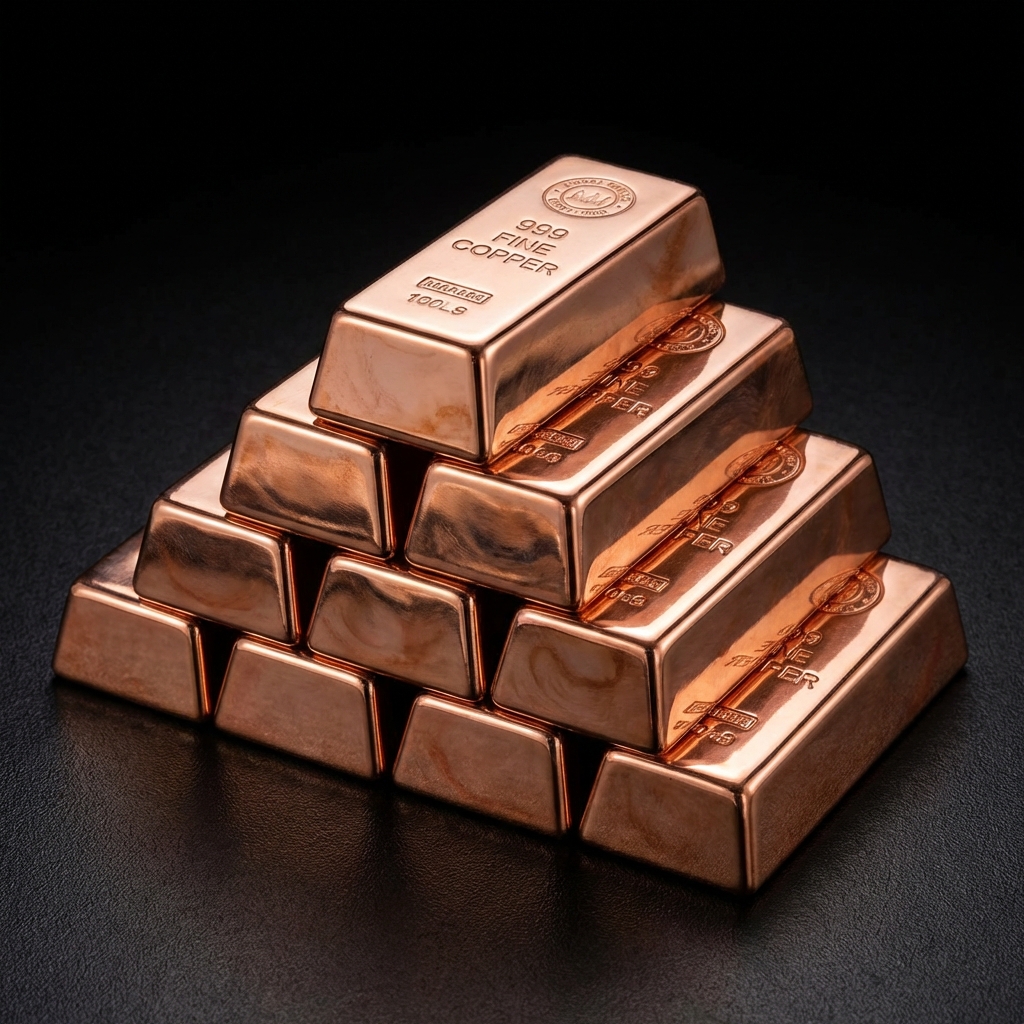
Bars represent the most cost-effective way to accumulate physical copper. They’re typically .999 fine copper and come in standardized weights.
| Bar Size | Typical Weight | Approximate Premium Over Spot | Best For |
|---|---|---|---|
| 1 kg (2.2 lbs) | ~35 oz | 35-50% | Beginners, small positions |
| 5 kg (11 lbs) | ~176 oz | 25-35% | Moderate investors |
| 10 kg (22 lbs) | ~353 oz | 20-30% | Serious accumulators |
| 1 lb bars | ~16 oz | 40-60% | Gifting, small purchases |
Recommended Brands:
- Geiger Edelmetalle (Germany): Security line design, excellent reputation, expect 30-40% premiums
- Scottsdale Mint: “Stacker” bars with interlocking design, popular in US market
- Baird & Co (UK): London-based, VAT-exempt for UK investors
- Metalor: Swiss refiner, higher premiums but recognized globally
- Sunshine Minting: US-based, good balance of quality and price
Avoid “art bars” with heavy designs or commemorative themes unless you’re specifically collecting. These often carry 50-100% premiums that you’ll never recover on resale.
Copper Rounds and Coins
Copper rounds look like coins but carry no face value or government backing. They’re produced by private mints primarily for collectors and stackers.
Bullion Rounds (1 oz, 1 lb):
- Premiums: 50-100% over spot for 1 oz pieces
- Examples: “Buffalo” design rounds, Walking Liberty copies
- Verdict: Poor value proposition unless buying 1 lb+ sizes
Collectible/Numismatic Copper:
- Pre-1982 US pennies (95% copper): ~$3.00+ per pound of copper content
- Historical copper tokens and medals
- Limited edition proof rounds
The math rarely works for 1 oz copper rounds. At current spot prices around $4.50/lb, a 1 oz round contains roughly $0.28 worth of copper. When dealers charge $2-4 per round, you’re paying 700-1300% over melt value. Buy these for enjoyment, not investment.
Industrial Forms (For Serious Investors Only)
If you’re considering significant copper exposure (tens of thousands of dollars), industrial forms become relevant:
- Copper Cathodes: LME-registered 99.99% pure sheets, ~250 lbs each
- Copper Wire Rod: Drawn wire on spools
- Copper Billet: Raw casting material
Challenges:
- Minimum orders typically 10,000+ lbs
- Requires commercial storage or warehouse receipts
- Limited resale market outside industrial users
- Delivery and handling complications
For 99% of investors, bullion bars are the only practical physical option.
Where to Buy Physical Copper
Online Precious Metals Dealers (US Focus)
| Dealer | Copper Selection | Shipping Threshold | Notes |
|---|---|---|---|
| APMEX | Excellent | Free over $200 | Largest selection, reliable but premiums on higher side |
| JM Bullion | Good | Free over $200 | Competitive pricing, frequent promotions |
| SD Bullion | Moderate | Free over $200 | Good for bulk purchases |
| Provident Metals | Moderate | Free over $200 | Competitive on 1 lb+ sizes |
| Money Metals Exchange | Limited | Free over $500 | Educational resources, good for beginners |
Shopping Tips:
- Compare total cost including shipping and insurance
- Check minimum order requirements for free shipping
- Look for “volume discount” tiers on 10+ bar purchases
- Sign up for dealer newsletters—copper promotions are common
European Dealers
- GoldCore (Ireland): VAT-exempt storage options
- BullionByPost (UK): Good selection, VAT applies
- GoldSilver (EU): Storage in Singapore or Switzerland available
Critical for EU buyers: VAT typically adds 19-27% to copper purchases. Some dealers offer bonded warehouse storage to defer VAT until withdrawal.
Local Coin Shops
Advantages:
- No shipping damage risk
- Immediate possession
- Potential for negotiation
- Build relationships for future sales
Call ahead—many shops don’t stock copper regularly. Expect to pay 10-20% more than online dealers for the convenience.
Direct from Mints
- Scottsdale Mint: Direct sales, occasional exclusive designs
- Geiger: Minimum order requirements for direct purchases
- National mints: Generally don’t produce copper bullion (exception: some commemorative issues)
eBay: Proceed with Extreme Caution
eBay copper is a minefield of overpriced “collectibles” and questionable authenticity. If you must buy here:
- Only purchase from dealers with 10,000+ feedback and 99%+ positive rating
- Verify the seller specializes in metals, not random collectibles
- Avoid anything labeled “rare,” “limited,” or “collectible edition”
- Check sold listings to understand true market value
- Never buy copper-plated items masquerading as solid copper
Understanding Premiums & Spot Price
Why You Pay 30-100% Over Spot
Copper’s spot price (currently around $4.20-4.80/lb) represents the wholesale industrial price for large tonnage transactions. Retail bullion involves additional costs:
- Manufacturing: Melting, casting, stamping, finishing
- Distribution: Shipping from refiner to dealer
- Dealer margin: 10-20% typical
- Low value density: Copper requires handling 500x more weight than gold for equivalent value
Calculating True Cost Per Ounce
Example: 1 kg (35.27 oz) copper bar
- Purchase price: $65
- Spot value: $35.27 × $0.28/oz = $9.88
- Premium: ($65 - $9.88) / $9.88 = 558% over spot

Cost per ounce: $65 ÷ 35.27 oz = $1.84/oz| Form | Content Value | Typical Price | Premium | Cost/Oz |
|---|---|---|---|---|
| 1 oz Round | $0.28 | $2.50 | 793% | $2.50 |
| 1 lb Bar | $4.50 | $12 | 167% | $0.75 |
| 1 kg Bar | $9.88 | $50 | 406% | $1.42 |
| 10 kg Bar | $98.80 | $130 | 31% | $0.37 |
Key Insight: The only way to approach reasonable premiums is buying 10 kg (22 lb) bars or larger. Smaller sizes are dramatically inefficient.
Storage Options: The Hidden Cost
Copper’s low value density makes storage a genuine challenge. A $10,000 gold position fits in your pocket. The equivalent copper position weighs roughly 2,200 pounds.
Home Storage
Pros:
- No ongoing fees
- Immediate access
- No counterparty risk
Cons:
- Space requirements (10 kg bar = size of a hardcover book)
- Weight (10 bars = 220 lbs)
- Security concerns
- Insurance challenges
Practical Setup:
- Climate-controlled environment (copper tarnishes in humidity)
- Fireproof safe rated for documents (weight limit critical)
- Desiccant packs to prevent oxidation
- Keep original packaging for resale value
Insurance: Most homeowner policies exclude precious metals or have low sub-limits ($1,000-2,500). Schedule a rider specifically for bullion storage—expect $10-20 per $1,000 annually.
Safe Deposit Boxes
Cost: $50-300/year depending on box size
Limitations:
- Most banks offer limited weight capacity
- No insurance coverage (read the fine print)
- Access limited to banking hours
- Some banks prohibit bullion explicitly
Verdict: Suitable for small positions (under 50 kg). Verify weight limits before committing.
Professional Vault Storage
| Provider | Locations | Cost (annual) | Minimum | Notes |
|---|---|---|---|---|
| Brinks | Global | 0.5-1.0% of value | $10,000+ | Industry standard, fully allocated |
| Loomis | US/EU | 0.5-0.8% | $25,000+ | Strong European presence |
| Malca-Amit | Global | 0.6-1.2% | $50,000+ | Singapore popular for tax reasons |
| Hard Assets Alliance | US | 0.5-0.7% | None | Retail-focused, integrated with dealers |
| Silver Bullion (Singapore) | Singapore | 0.5-0.8% | None | VAT-free jurisdiction |
Allocated vs. Unallocated:
- Allocated: Specific bars with serial numbers in your name
- Unallocated: General claim on metal pool (avoid for copper)
For positions under $50,000, vault fees may consume 1-2% annually—significant drag on returns.
Red Flags & Scams to Avoid
Common Traps
-
“Investment Grade Copper” Certificates
- No physical delivery option
- Counterparty risk with no regulatory protection
- Often sold by telemarketing operations
-
Overpriced “Collectible” Rounds
- $5+ for 1 oz rounds containing $0.28 metal value
- Claims of future numismatic value are speculative
-
Copper-Plated Fakes
- Zinc or steel cores with copper coating
- Test with magnet (copper is non-magnetic)
- Weigh suspicious pieces (copper is dense)
-
Pre-1982 Penny Hoarding Schemes
- Sorting and storage costs exceed potential upside
- Melting ban still in effect in US
- Premiums already reflect copper content
-
“Off-Market” Industrial Deals
- Claims of direct refinery access at spot price
- Advance fee fraud common
- No legitimate dealer sells at spot to retail
Verification Checklist
- Dealer has physical address and phone number
- BBB rating checked (if US-based)
- Reviews on independent sites (not just their website)
- Clear return policy stated
- Products marked with weight and purity
- Original packaging intact
Liquidity: How to Sell Later
Physical copper is significantly less liquid than gold or silver. Plan your exit strategy before buying.
Selling Options
| Channel | Expected Recovery | Timeline | Effort |
|---|---|---|---|
| Original dealer buyback | 80-90% of retail | Immediate | Low |
| Other online dealers | 75-85% of retail | 1-2 weeks | Medium |
| Local coin shops | 70-80% of retail | Immediate | Low |
| eBay (DIY) | 85-95% of retail | 1-4 weeks | High |
| Industrial recyclers | Spot price minus 10-20% | Varies | High |
| Peer sales | 90-100% of retail | Unpredictable | High |
Maximizing Resale Value
- Keep original packaging and certificates
- Document purchase receipts for provenance
- Store in climate-controlled environment
- Maintain bars in pristine condition
- Build relationships with dealers before you need to sell
Reality Check: Expect to lose 20-30% on round-trip transaction costs (buy premium + spread on sale). Copper must appreciate significantly just to break even.
Tax Considerations
United States
- Federal capital gains: Copper is considered a collectible—28% maximum rate on gains held over one year
- Short-term gains: Taxed as ordinary income
- Sales tax: Varies by state; some exempt bullion, others don’t
- 1099 reporting: Generally not required for copper sales (unlike gold/silver in certain quantities)
European Union
- VAT: Typically 19-27% on purchase (varies by country)
- Capital gains: Varies; some countries exempt after holding period
- Storage solutions: Bonded warehouses can defer VAT until withdrawal
United Kingdom
- VAT: 20% on copper bullion (gold and silver exempt)
- CGT: Subject to capital gains tax (annual allowance applies)
Disclaimer: Tax laws change frequently. Consult a tax professional for current regulations in your jurisdiction.
Bottom Line: Is Physical Copper Worth It?
The Case For Physical Copper
- Direct exposure to industrial demand without paper counterparty risk
- Potential hedge against currency devaluation
- Tangible asset outside financial system
- Green energy transition demand driver
- Low correlation with traditional assets
The Case Against
- Massive premiums destroy value on purchase
- Storage costs and logistics for meaningful positions
- Poor liquidity compared to gold/silver
- No historical monetary premium
- Better exposure through ETFs, miners, or futures for most investors
Who Should Buy Physical Copper?
✓ Long-term holders who believe copper will double or triple ✓ Preppers wanting industrial barter metal ✓ Diversifiers with established gold/silver positions ✓ Industry professionals who understand the metal intimately ✗ Short-term traders (premiums make this impossible) ✗ Small investors (better to buy copper ETF at 0.29% expense ratio) ✗ Those seeking liquidity (gold/silver far superior)
Quick Start Checklist
Ready to buy your first physical copper? Follow this sequence:
Before You Buy
- Verify copper fits your investment goals and timeline
- Determine total position size (recommend under 5% of metals allocation)
- Calculate true cost per ounce including all premiums
- Research and select 2-3 reputable dealers
- Compare total landed cost across dealers
- Arrange storage solution before delivery
Purchase Process
- Start with small test order (1-2 kg) from chosen dealer
- Inspect immediately upon receipt
- Verify weight and purity markings
- Photograph packaging and bars with serial numbers
- Store documentation securely (separate from metal)
- Add to inventory spreadsheet with cost basis
Ongoing Management
- Review storage conditions quarterly
- Monitor spot price vs. your cost basis
- Build relationships with potential future buyers
- Rebalance if position grows disproportionately large
- Maintain insurance coverage documentation
Final Thoughts
Physical copper bullion is not a get-rich-quick scheme. It’s a cumbersome, expensive way to bet on industrial metal demand. For every story of copper doubling in price, there are investors still underwater from premiums paid years ago.
That said, for those committed to tangible assets and willing to navigate the logistics, copper offers something unique: exposure to a metal essential to modern civilization, held directly in your possession or in allocated storage.
Buy with eyes wide open to the costs. Store with attention to security and condition. Sell with patience to recover maximum value. And never allocate more than you can afford to have locked in heavy metal for years.
The information provided is for educational purposes only and does not constitute investment advice. Physical copper carries significant risks including illiquidity, storage costs, and potential for capital loss. Consult a qualified financial advisor before making investment decisions.