Copper Recycling: How Much Copper Is Recycled Annually?
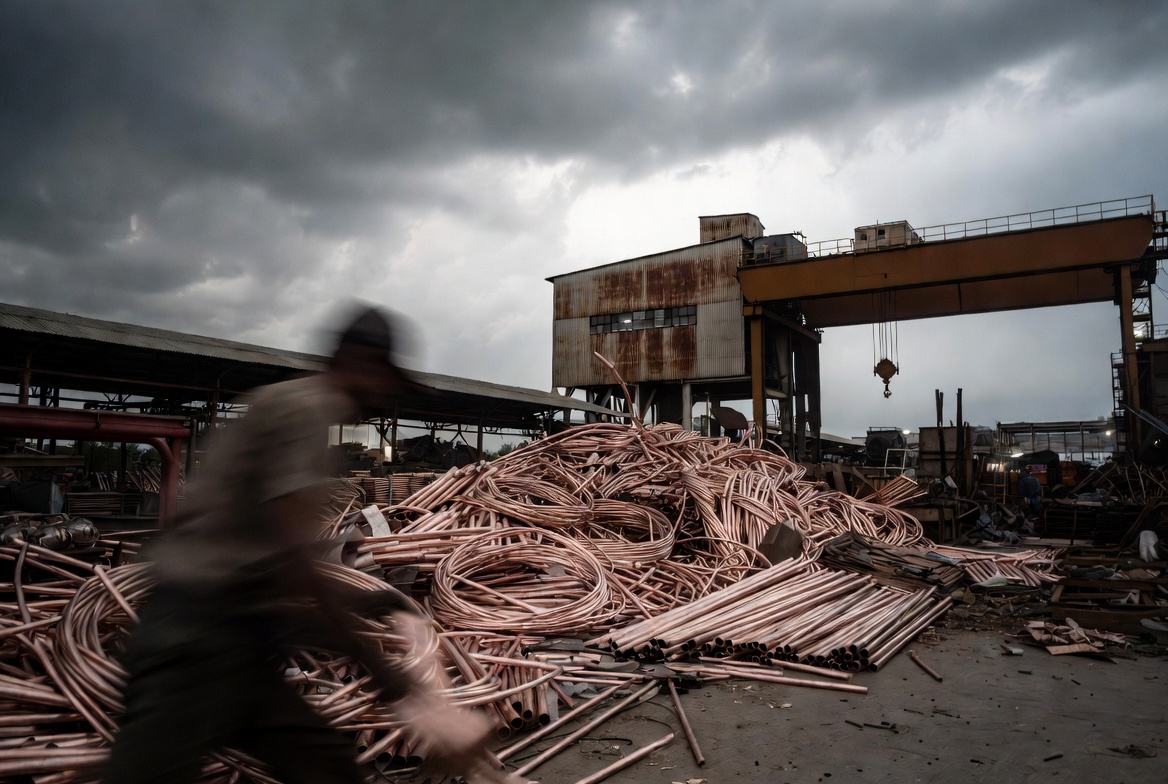
Copper: The Infinitely Recyclable Metal
Unlike fossil fuels that vanish in a puff of smoke, copper is eternal. It can be recycled infinitely without any loss of performance or quality. This unique property makes copper the poster child of the circular economy—and a critical, often misunderstood, component of global supply dynamics.
For investors watching the copper market, understanding recycling is essential. With primary mining facing grade decline, water scarcity, and permitting delays, many ask: Can’t we just recycle our way out of the supply crunch?
The answer is more nuanced than a simple yes or no. While recycling currently supplies roughly 35% of global copper demand, its growth is constrained by physical realities: copper’s long service life, the “societal stock” trapped in infrastructure, and quality limitations for high-end applications.
This article breaks down the data, the process, and the investment implications of the $100+ billion copper recycling industry.
The Scale of Global Copper Recycling
Production Breakdown: Primary vs. Secondary
The global copper market in 2024 was approximately 26 million tonnes, split between newly mined (primary) and recycled (secondary) metal:
| Source | Volume (Mt) | Share | 5-Year CAGR |
|---|---|---|---|
| Primary (Mined) | ~17.0 | 65% | +1.8% |
| Secondary (Recycled) | ~8.9 | 35% | +3.2% |
| Total | ~25.9 | 100% | +2.3% |
Data: ICA, Wood Mackenzie, BIR (2024 estimates)
Historical Trends
| Year | Secondary (Mt) | Global Demand (Mt) | Recycling Rate |
|---|---|---|---|
| 2000 | 4.2 | 14.8 | 28% |
| 2010 | 6.1 | 19.2 | 32% |
| 2020 | 7.8 | 24.1 | 32% |
| 2024 | 8.9 | 25.9 | 34% |
| 2030 (Est.) | 11.5 | 31.0 | 37% |
While recycling volumes have more than doubled since 2000, the recycling rate has only crept up from 28% to 34%. The bottleneck isn’t willingness—it’s availability of scrap.
Chart Concept: “Copper Recycling Gap” — Dual-axis chart showing steady growth in secondary supply (green bars) against exponential demand growth (red line), highlighting the widening absolute deficit.
Types of Copper Scrap: A Quality Hierarchy
| Grade | Description | Cu Content | Price vs. Spot | Primary Uses |
|---|---|---|---|---|
| No. 1 Bare Bright | Clean, uncoated wire | 99.9%+ | 95-98% | Bus bars, high-end electrical |
| No. 1 Copper Wire | Clean wire, minimal oxidation | 99%+ | 90-93% | Wire rod, electrical components |
| No. 2 Copper Wire | Mixed wire with coatings | 96-98% | 85-88% | Refining feedstock |
| Light Copper | Sheet, gutters, roofing | 92-96% | 80-84% | Alloy production |
| Copper Alloys | Brass, bronze | 60-90% | 60-75% | Castings, hardware |
| E-Waste | Circuit boards, motors | 10-20% | Variable | Smelter feed, PM recovery |
No. 1 Bare Bright commands prices near LME spot because it requires minimal processing. At the other end, e-waste contains valuable copper but in such low concentrations that processing economics depend on co-recovered gold, silver, and palladium.
Sources of Scrap Copper
1. Post-Consumer Scrap (“Old Scrap”)
Discarded products reaching end-of-life: demolished wiring, replaced plumbing, obsolete electronics.
- Volume: ~40% of total scrap
- Lead time: 25-50+ years from installation to recovery
- Price sensitivity: High—flows increase when prices spike
2. Pre-Consumer/Industrial Scrap (“New Scrap”)
Manufacturing waste: offcuts, trimmings, defective products. Highest quality stream.
- Volume: ~35% of total scrap
- Lead time: Weeks to months
- Price sensitivity: Low—constant flow tied to manufacturing
3. End-of-Life Infrastructure
Demolition waste from buildings, vehicles, and industrial equipment.
- Volume: ~25% of total scrap
- Lead time: Decades
The E-Waste Opportunity
Electronic waste is the fastest-growing scrap category. A single smartphone contains only ~0.03g of copper, but global e-waste generation exceeds 60 million tonnes annually. The copper is there—it’s just diffuse and mixed with hazardous materials.
Chart Concept: “Copper Scrap Sources Flow” — Sankey diagram showing societal stock (700+ Mt in use) through waste streams to secondary smelters.
The Recycling Process
Modern copper recycling varies by feedstock quality:
Collection & Sorting: Visual inspection, magnets, XRF analyzers determine copper content.
Size Reduction & Separation:
- Shredding to liberate copper from insulation/plastic
- Air classification for light plastics
- Eddy current separation by conductivity
- Dense media separation by weight
Smelting & Refining: Lower-grade scrap goes to secondary smelters for melting, fluxing, and electrolytic refining to 99.99%+ cathode quality.
High-grade scrap (No. 1 Bare Bright) bypasses smelting entirely, going directly to cathode or rod production.
Regional Recycling Leaders
| Region | Recycling Rate | Secondary Volume | Key Characteristics |
|---|---|---|---|
| Europe (EU+UK) | 45% | 1.8 Mt | Strict mandates, mature infrastructure |
| North America | 32% | 1.4 Mt | Large industrial scrap, automotive-driven |
| China | 28% | 3.2 Mt | Largest absolute recycler, import restrictions |
| Japan | 52% | 0.6 Mt | Highest rate globally, advanced e-waste processing |
| Rest of World | 15-25% | 1.9 Mt | Emerging infrastructure, informal sector |
Europe: The Policy Driver
The EU’s Circular Economy Action Plan and extended producer responsibility laws are pushing recovery rates higher with targets of 65% municipal recycling by 2035.
China: The Volume King
Despite a lower rate, China processes more absolute tonnes than any nation. Following the 2018 “National Sword” ban on waste imports, Chinese recyclers invested heavily in domestic collection networks.
Can Recycling Solve the Supply Crisis? The Math Says No
Here’s the uncomfortable truth: Recycling mathematically cannot prevent the copper deficit.
The Growth Gap
Global copper demand is projected to grow 4-5% annually through 2030—approximately 1.2 million additional tonnes per year.
Recycling supply grows at roughly 3% annually—about 250,000 tonnes per year of additional supply.
The deficit: Even with aggressive recycling growth, primary mining must deliver ~950,000 tonnes of new supply annually. With major mines facing depletion and 16-year development timelines, this is the crux of the bull case for copper prices.
The Societal Stock Constraint
Approximately 700 million tonnes of copper is currently “in use”—wiring, pipes, motors, coins. This is the “societal stock” that will eventually become scrap.
But copper’s service life averages 25-40 years for building wire, 30+ years for plumbing, and 10-15 years for vehicles. The copper installed during the 1990s building boom is only now returning to market.
Chart Concept: “The Recycling Time Lag” — Stacked area chart showing copper installations by decade and when stocks become available as scrap, illustrating the 20-40 year delay.
Quality Constraints
Even with abundant scrap, certain applications require virgin copper:
- Semiconductor manufacturing: Ultra-high purity requirements
- Certain alloys: Precise composition control
- Some electrical specs: Trace element limits
Industry estimates suggest 60-65% recycling rates represent a practical ceiling—not from technical limits, but quality requirements and infrastructure time lags.
The Business of Scrap
Major Players
| Company | HQ | Annual Secondary (kt) | Business Model |
|---|---|---|---|
| Aurubis | Germany | 700+ | World’s largest recycler; integrated smelter |
| Jiangxi Copper | China | 500+ | State-owned; massive domestic scrap ops |
| LS-Nikko | Korea | 300+ | Secondary smelting focus |
| Glencore | Switzerland | 400+ | Mining + recycling integration |
| Umicore | Belgium | 100+ | Precious metals + copper from e-waste |
Profit Margins
Recycling profitability depends on the scrap spread—the difference between scrap purchase prices and refined copper selling prices:
- Typical spreads: $400-800/tonne for high-grade scrap
- Margin drivers: Copper price level, scrap availability, energy costs
- Volatility: Less than mining but significant; scrap prices lag LME moves
Investment Implications
1. Pure-Play Exposure
European recyclers like Aurubis offer the cleanest exposure to copper recycling trends. As the supply deficit intensifies and ESG mandates tighten, these companies may command valuation premiums.
2. Integrated Miners
Companies like Glencore and BHP are increasingly investing in recycling capabilities to hedge against resource depletion. This diversification may reduce earnings volatility.
3. ESG-Driven Flows
As institutional investors prioritize low-carbon exposure, “green copper” from recycling sources may command price premiums—structurally improving recycler margins.
Advantages of Recycling Stocks:
- Lower capital intensity than mining
- ~60% lower carbon footprint than primary production
- Less resource depletion risk
- Shorter payback periods on expansion
Risks:
- Scrap supply constraints limit growth
- Energy price sensitivity
- Regulatory changes (import/export restrictions)
Future Outlook
Urban Mining Revolution
Cities are becoming the mines of the future. The concentration of copper in urban infrastructure exceeds many natural ore bodies. The challenge is access—you can’t just strip-mine a city.
Emerging technologies:
- AI-powered sorting: >95% accuracy identifying copper-bearing materials
- Advanced hydrometallurgy: Acid leaching of low-grade e-waste
- Robotic disassembly: Automated copper recovery from complex products
Policy Tailwinds
- EU Circular Economy Action Plan: Mandatory recycled content targets
- US Inflation Reduction Act: Tax incentives for domestic recycling infrastructure
- China’s 14th Five-Year Plan: Scrap metal utilization rate targets
The 2030 Projection
By 2030, secondary copper production could reach 11-12 million tonnes annually—still representing only 35-37% of total demand as the denominator grows faster. Recycling helps, but doesn’t eliminate the need for new mines.
Conclusion: Recycling as Complement, Not Replacement
Copper recycling is a remarkable success story—a $100+ billion industry that keeps metal flowing while avoiding the environmental costs of new mining. It supplies over one-third of global demand and will grow in importance as installed stocks mature.
But for investors, the key takeaway is this: Recycling is a complement to mining, not a substitute. The 20-40 year time lag between copper installation and recovery, combined with explosive demand growth from electrification, means secondary supply cannot prevent the structural deficit looming in the late 2020s.
The smart play? Exposure to both. Quality miners with long-life assets will benefit from price appreciation. Established recyclers with ESG credentials will capture growing scrap flows and potential green premiums.
Copper may be infinitely recyclable, but it’s not infinitely available. The atoms are out there—trapped in walls, buried in landfills, circulating in economies. Extracting them faster won’t happen without much higher prices to incentivize recovery.
For the copper bull, that’s a feature, not a bug.
Sources: International Copper Association (ICA), Bureau of International Recycling (BIR), Wood Mackenzie, European Copper Institute, USGS, company filings. Data as of March 2026.