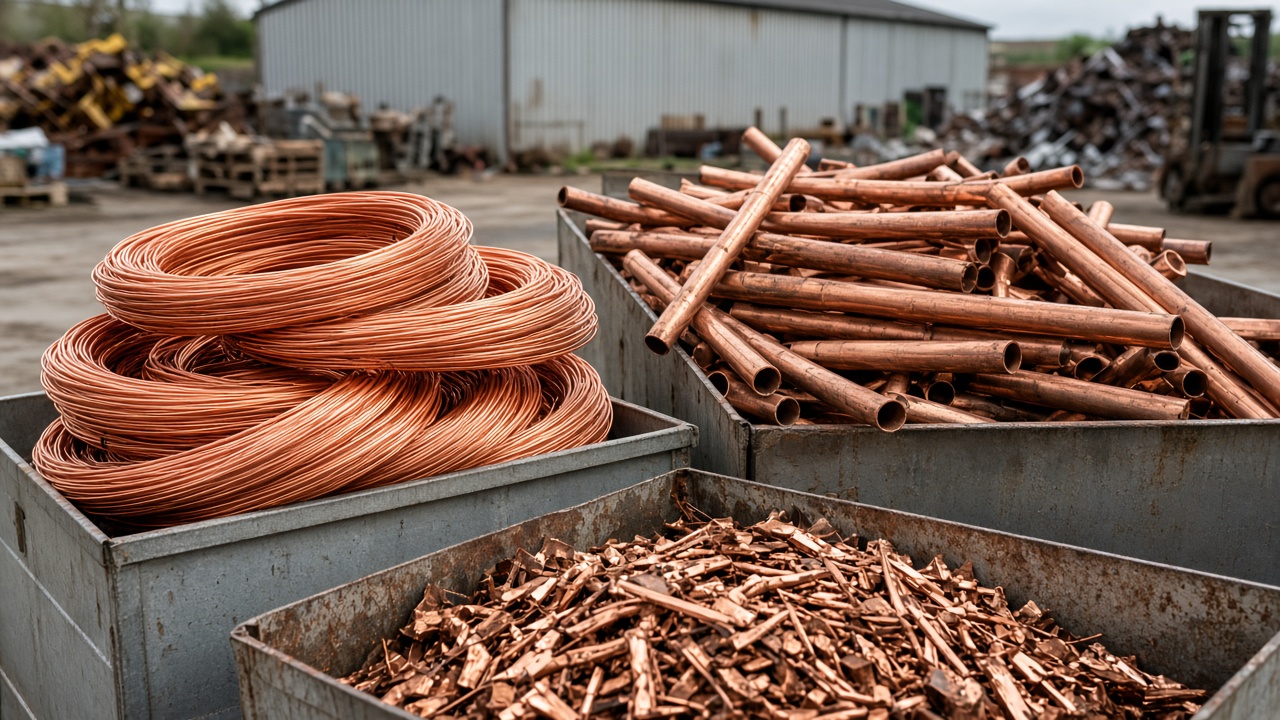
Scrap copper prices in the UK are quoted in pounds per kilogram at the yard gate, not in LME dollars per tonne on a dealing screen. The two are linked. When London cash copper sits near $14,529 per tonne in September 2026, UK scrap offers rise. They never match full exchange parity. Yards need margin for sorting, transport, contamination risk, and metal price swings between collection and sale.
This guide covers how UK scrap copper prices work in 2026, what bare bright and other grades mean on British yards, how to think in £/kg from LME and COMEX discounts, why regional quotes differ, and how to sell without cutting corners on law or safety. For grade definitions in more depth, use our scrap copper prices by grade guide. For a quick estimate, use the copper scrap calculator.
How UK scrap pricing links to LME and COMEX
UK merchants and large recyclers ultimately sell into markets that reference LME copper (and sometimes other regional benchmarks). Your local yard quote is a discounted, FX-adjusted, grade-adjusted slice of that chain.
A practical mental model:
- Start from LME cash in $/tonne (about $14,529/t in September 2026).
- Convert to £/kg using GBPUSD and the 1,000 kg per tonne factor.
- Apply a grade factor (bare bright near the top, insulated and mixed lower).
- Subtract the yard’s margin, contamination haircut, and any minimum load friction.
COMEX $/lb headlines help for cross-checks if you follow US scrap content, but UK conversations are £/kg and LME-linked. Do not expect a high-street quote to equal converted LME. Realistic bare bright payouts often land in a band well below full melt value once margin is included. When people search “scrap copper price per kg uk”, they are searching for that yard-gate number, not the exchange print.
Typical UK grades you will hear
UK yards use language that overlaps US ISRI grades, with local shorthand. Exact names vary by merchant. Always ask what the yard means by each ticket price.
Bare bright copper UK
Bare bright (sometimes called bright wire) is clean, uncoated, unalloyed copper wire, free of solder, paint, and heavy oxidation. It is the premium grade in most UK searches for “bare bright copper uk”.
What usually qualifies:
- Stripped copper wire of sufficient thickness
- Clean, dry, no insulation fragments left on the metal
- No steel ends, plugs, or mixed alloys
What usually fails:
- Green corrosion, heavy tarnish, or burnt residue
- Thin wire that yards reclassify downward
- Pipe sold as wire (pipe is often a different ticket)
Bare bright earns the best £/kg. Stripping thick insulated cable can pay if labour time is honest. Burning insulation to “clean” wire is unsafe and can get material rejected or reported. See the legal and safety section below.
Clean copper / No. 1 style material
Clean copper tube, busbar, and heavy wire that is not quite bare bright often sits on the next ticket. Soldered joints, light oxidation, or mixed solid shapes can push material here. Prices are below bare bright but still strong when LME is elevated.
No. 2 / dirty copper
Painted tube, solder-heavy fittings, and copper with attachments fall here. Expect a clear step down in £/kg. Sorting before you visit often pays more than mixing everything into one bin.
Insulated cable (various recovery rates)
Yards price insulated wire by estimated copper recovery, thickness, and insulation type. Thick mains cable with high copper content pays more per kilogram of cable than thin data wire. Some yards quote “cable” as a single blended price. Others split high-grade and low-grade insulated.
Braziery, motors, and radiators
Electric motors, transformers, and brass/copper radiators are usually separate categories. Copper content is embedded with steel and aluminium. Do not assume motor scrap pays like bare bright. If you can dismantle legally and safely, clean copper separated from steel will usually price better than intact motors, but labour and tooling costs matter.
For a fuller grade ladder and global context, see scrap copper prices by grade 2026.
Thinking in £/kg without fooling yourself
Exchange prices move daily. Yard boards move in steps and can lag. Use ranges, not false precision.
Illustrative September 2026 framing (indicative only, not a live quote):
| Grade (typical UK yard language) | Relative to top ticket | Notes |
|---|---|---|
| Bare bright wire | Highest | Clean stripped wire |
| Clean / No. 1 solids | High | Tube, heavy clean copper |
| No. 2 / dirty | Mid | Paint, solder, attachments |
| High-grade insulated | Mid to mid-high per kg of cable | Depends on recovery |
| Low-grade insulated / thin wire | Lower | Labour vs payout often poor |
| Motors / mixed | Lowest copper-equivalent | Pay for embedded copper only |
To sense-check a quote:
- Convert LME $/t to £/kg with the day’s FX.
- Multiply by a realistic payout ratio for the grade (often well below 100% of melt).
- Compare to the yard board.
- If the yard is far above the sense-check, ask what grade they assumed. If far below, call a second yard.
Use the calculator to translate weights into value estimates before you load the van. Then confirm with live local tickets. Online averages are not a contract.
Regional variation across the UK
Scrap copper prices UK-wide are not uniform.
Why quotes differ by region
- Distance to processors and ports. Yards near major recycling hubs or export logistics can sometimes pay tighter discounts.
- Local competition. Dense urban areas with several merchants may bid more aggressively for clean loads.
- Load size. A half-bin of mixed cable in a rural yard may price worse per kg than a sorted tonne in the Midlands or South East.
- Theft and compliance costs. Higher policing and paperwork overhead can widen discounts in some areas.
- Cash versus account terms. Account customers with regular tonnage often see better numbers than one-off walk-ins.
Practical approach
Call two or three licensed yards the morning you plan to sell. Ask for today’s bare bright, clean copper, and insulated cable tickets. Confirm whether prices assume a minimum weight. Photograph or keep the ticket. Regional shopping matters more when you have more than a small household load.
How to prepare material so you keep more £/kg
- Sort by grade. Do not bury bare bright under dirty tube.
- Remove steel and brass where practical. Mixed attachments invite haircuts.
- Strip only when it pays. Thick cable can be worth stripping. Fine wire often is not.
- Keep it dry and clean. Mud and oil reduce appeal and can change grading.
- Weigh at home if you can. Know your approximate kg before you arrive.
- Ask how the yard grades cable. Recovery assumptions differ.
Small improvements in sorting often beat hunting for a mythical “best price in Britain” while delivering unsorted scrap.
Legal and safety notes (read these)
UK scrap selling is regulated. Yards must follow rules on identification, payment methods, and record-keeping designed to discourage metal theft. Expect to show ID. Do not be surprised by non-cash payment policies.
Do not burn cable
Burning insulation off wire is hazardous. It releases toxic fumes, creates fire risk, and produces burnt copper that yards often downgrade or refuse. It can also attract enforcement attention. Mechanical stripping or selling as insulated is the legitimate route.
Prove the metal is yours
Stolen cable from utilities and railways is a serious crime. If you cannot explain the source, do not sell it. Legitimate sources include your own renovation waste, licensed job clear-outs, and material you are authorised to remove.
Work safely
- Cut cable with proper tools, not improvised methods that risk injury.
- Watch for live electrical environments. Only take cable that is confirmed dead and authorised for removal.
- Lift with care. Copper is dense. Back injuries are common in DIY scrap runs.
- Store scrap securely. Visible copper invites theft from your own premises.
Environmental common sense
Do not dump insulation waste illegally after stripping. Dispose of plastic waste through proper channels. Responsible recycling is part of keeping yards willing to deal with small sellers.
Using the calculator and grade guide together
A sensible workflow for UK sellers:
- Sort material into bare bright, clean solids, dirty copper, and insulated.
- Weigh each pile.
- Run the weights through the copper scrap calculator.
- Cross-check grade expectations in scrap copper prices by grade.
- Phone local yards for live £/kg tickets.
- Sell where the combination of price, distance, and trust works.
The calculator helps you avoid fantasy maths. The yard ticket is what you actually get paid.
What moves scrap copper prices UK through 2026
- LME cash level. Primary driver of the ceiling.
- GBPUSD. A weaker pound can lift £/kg even if dollar copper is flat.
- Yard inventories and export demand. Local glut or tightness changes discounts.
- Cable theft crackdowns. Can tighten acceptance standards and paperwork.
- Energy and labour costs at processors, which feed into margins.
When LME is near $14,529/t, household and trade scrap is more valuable than in low-price years. That also increases theft incentive, which is why compliance at the yard has hardened.
Trade sellers versus DIY loads
Electricians, demolition firms, and HVAC engineers often get better effective prices because they deliver regular tonnage, cleaner streams, and predictable grades. DIY sellers with mixed bags should focus on sorting and choosing a reputable yard rather than expecting contractor account pricing.
If you generate scrap regularly, ask about account terms, collection services, and grade education from the merchant. A short conversation can raise your average £/kg more than reading another headline about LME highs.
Frequently asked questions
What is the scrap copper price per kg in the UK right now?
It depends on grade, yard, region, and the day’s LME and FX. There is no single national number. Call local licensed yards for bare bright and other tickets, and use the calculator for a ballpark before you go.
What is bare bright copper worth in the UK?
Bare bright is the top common wire grade: clean, uncoated copper wire. It pays the highest £/kg among standard household and trade grades, still at a discount to full LME melt after yard margin. Confirm today’s board price. See also grades explained.
Why is yard price below the LME copper price?
Yards pay for unsorted risk, processing, transport, overhead, and metal price moves. They also convert dollars to pounds. The gap is normal. A quote matching full LME would leave the yard no viable margin.
Should I strip insulated wire before selling?
Strip thick, high-recovery cable if you can do it safely and the £/kg uplift covers your time. Thin wire often fails that test. Never burn insulation.
Do UK yards pay cash for copper scrap?
Many follow rules that restrict or ban cash for scrap metal transactions and require ID. Expect bank transfer or similar recorded payment. Policies vary. Ask when you phone.
Is it legal to sell scrap copper in the UK?
Yes, if the metal is legitimately yours (or you are authorised to sell it) and you use a licensed scrap metal dealer who follows ID and payment rules. Selling stolen utility cable is a crime.
How do I get the best scrap copper prices UK yards will pay?
Sort grades, remove contaminants, sell larger clean loads where possible, compare two or three local tickets, and time sales when you already have volume rather than chasing every LME uptick with tiny loads.
Bottom line
Scrap copper prices UK sellers care about are £/kg yard tickets for bare bright, clean copper, dirty grades, and insulated cable. Those tickets sit below converted LME or COMEX melt value by design. Sort carefully, use the calculator and the grade guide, phone local yards, and keep the process legal and safe. No burning wire, no mystery cable, no fantasy parity with $14,529/t London cash.